
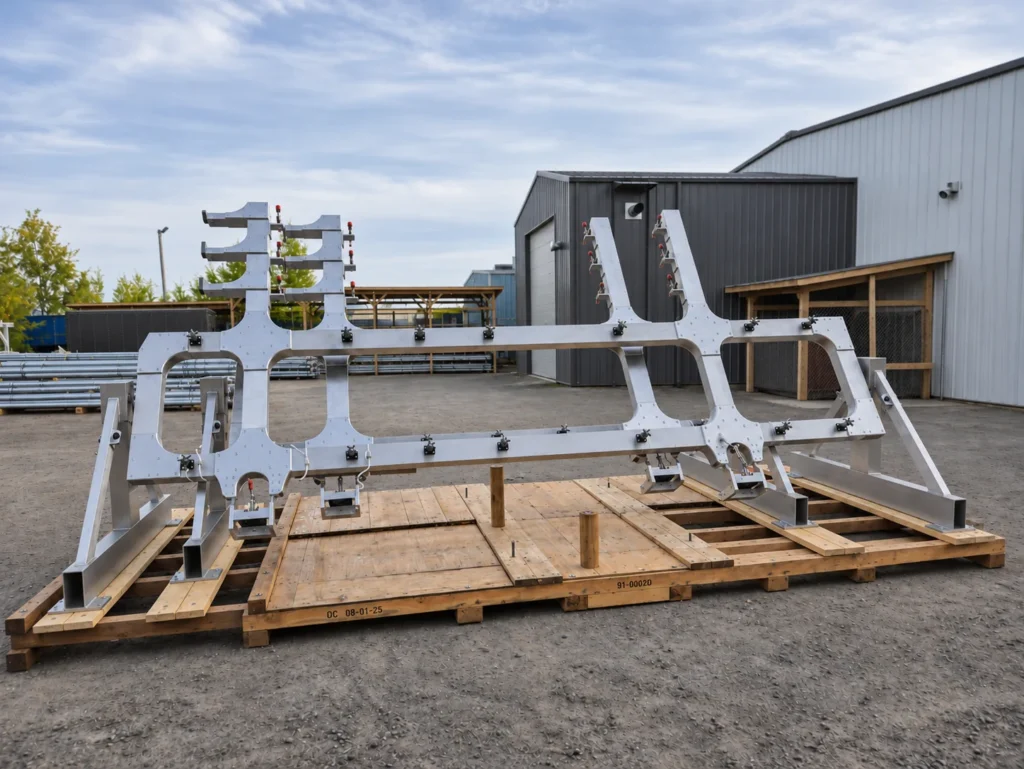
The real problem wasn’t holding the parts
It was getting accurate, repeatable assemblies without making every operator an expert in layout and fit-up. Different product lengths, heights and configurations had to move through the same production process. Measuring, repositioning and welding access all created opportunities for delay and inconsistency.
Build the process into the tooling
Four purpose-built fixtures, in two complementary designs, were developed around the complete manufacturing sequence. Fixed locating geometry establishes where parts belong. Dedicated spring-loaded and retractable clamps engage the correct configuration without routine fixture adjustment. Once the initial welds are complete, the clamps move out of the way for the remaining fabrication and assembly operations.
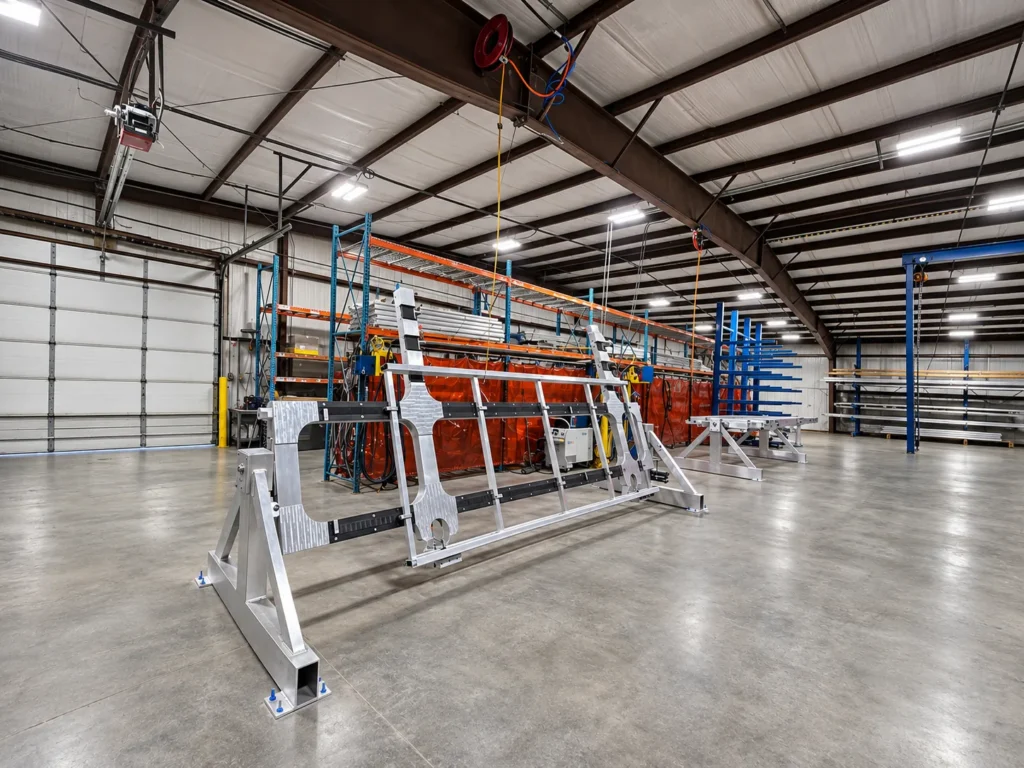
Make large assemblies easier to work on
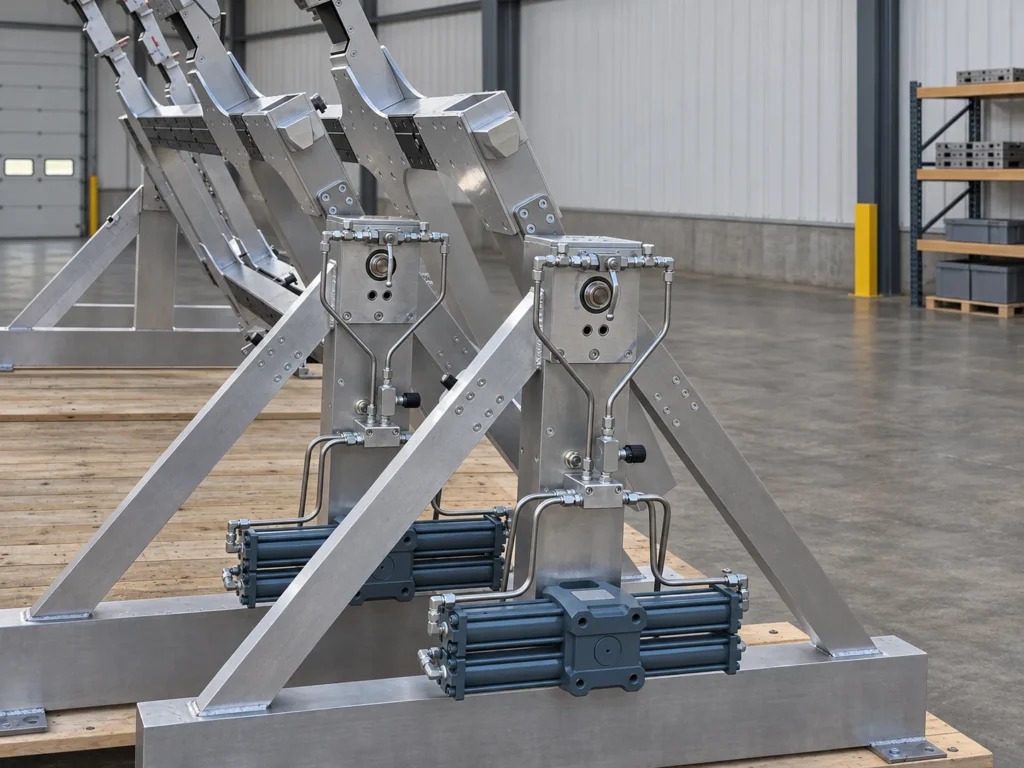
The tables rotate manually, but not casually. Their rotation axes were chosen to balance the range of supported assemblies. An integrated hydraulic system provides adjustable rotational resistance and locks the fixture at the chosen working angle, with a separate mechanical restraint available as a backup. Operators can bring the weld to a practical working position rather than working around an awkwardly positioned assembly.
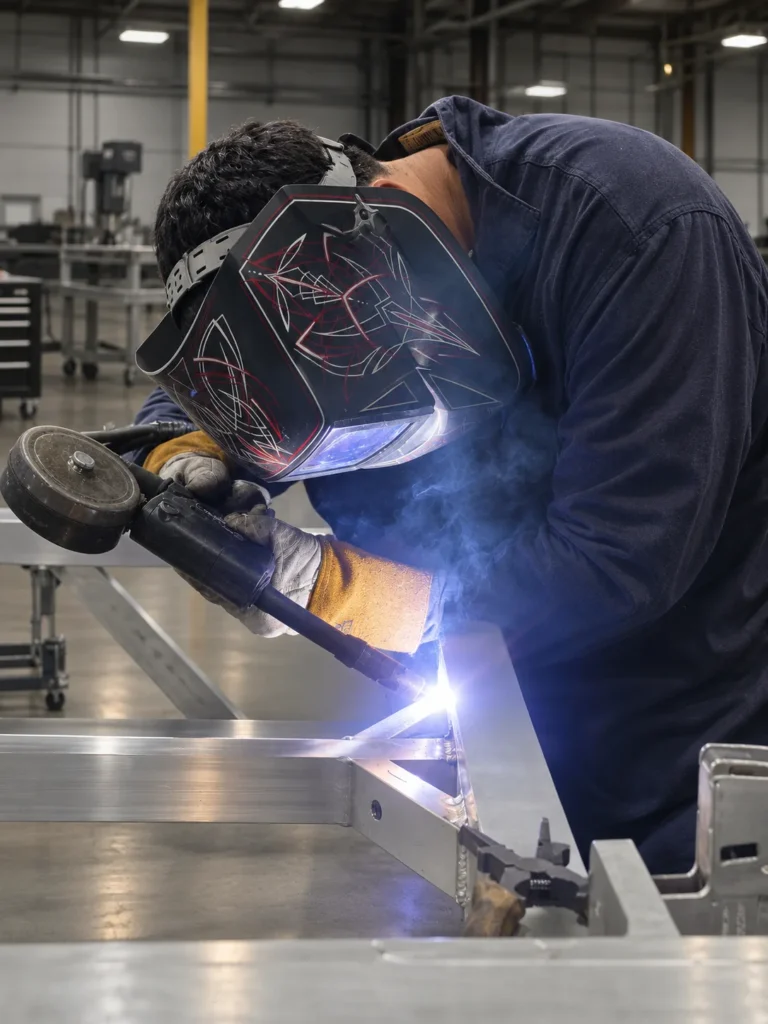
Solve the details between design and production
The assignment included mechanical design, manufacturing coordination, hands-on assembly, hydraulic-system troubleshooting, testing, installation and operator training. A problematic initial hydraulic installation was rebuilt, and the fluid-filling procedure refined to produce a firmer locking response. The fixtures were commissioned at two production facilities.
The outcome
The finished equipment brought location, clamping, welding access, final alignment and unloading together at one workstation. Instead of repeatedly measuring and fitting components, operators follow a process embodied in the equipment itself. That is the central achievement: production know-how translated into a practical, repeatable manufacturing system.